
NRC Transfers Versus Releases
The Northern Reception and Classification Center receives adult men entering the Illinois Department of Corrections from counties across Illinois. Its location in Will County does not show where a person was charged, lived, or will go after prison. IDOC describes NRC as a major statewide intake and processing center. Classification identifies needs, security factors, and an appropriate permanent institution.
Leaving NRC therefore often means an internal IDOC transfer. It does not mean release to the community. IDOC states there is no set processing timeframe. A person may move after classification, remain within a campus unit, later leave prison for parole or mandatory supervised release, or reach final discharge after supervision. Mandatory supervised release, often called MSR, is the period of state supervision that can follow a determinate prison sentence.
| NRC event | What it means | Confirmation |
|---|---|---|
| New IDOC location | Internal transfer | Status and Location |
| Community supervision | Physical prison release may have occurred | Last Paroled Date plus status |
| Projected Parole Date | Forecast, not completed release | Recheck IDOC and VINE |
| Final discharge | Sentence and supervision ended | IDOC or PRB record |
Confirm an NRC Release
Open the IDOC Individual in Custody Search. Search by IDOC number when possible because it is more precise than a name. The form also accepts last name and birth date. Open the matching profile and compare the IDOC number, descriptors, photograph, offense county, and sentence blocks before relying on the record.
- Search with the IDOC number or identifying details.
- Match the profile rather than relying on name alone.
- Read Parent Institution, Offender Status, and Location together.
- Compare Admission Date and all three parole or discharge fields.
- Check PRB records when parole, revocation, or final discharge is involved.
- Contact IDOC if a fully discharged record is no longer visible.
A new prison location is a transfer. A community-supervision status with a Last Paroled Date can support a physical release from prison, but current status still matters because a person may return after a violation. Projected dates can change. The Will County Sheriff’s databases do not cover the NRC episode unless the person also had a separate county-jail booking.
NRC disappearance is not release proof. Follow the IDOC number to the current institution or obtain a discharge record.
NRC Search Fields Explained
IDOC uses several fields that should not be merged. Parent Institution supplies an administrative affiliation. Location identifies the place or status currently shown. Offender Status helps distinguish incarceration, supervision, or another correctional state. Read all three before interpreting a date.
| IDOC field | Correct reading |
|---|---|
| Admission Date | Entry into the state custody episode |
| Projected Parole Date | Forecast of prison exit to supervision when applicable |
| Last Paroled Date | Historical parole or MSR event |
| Projected Discharge Date | Forecast for the end of sentence and supervision |
| Sentence Discharged? YES | Applies to that sentencing count, not always the whole record |
An active prison location makes a projected parole date forward-looking. A community status and Last Paroled Date indicate a past physical exit, subject to any later violation or return. Projected Discharge Date is later in concept because it concerns the complete sentence. The Projected Release Date page explains sentence credit and why estimates move.
The actual IDOC search form is the operational lookup. Save the IDOC number and the date checked so later changes can be compared.
NRC Records and Contact
Call NRC for facility routing, but use IDOC records channels for an official admission, transfer, parole, or discharge record. A precise request should identify the person and IDOC number, describe the requested event, and ask for existing dates and decision records. The Will County Sheriff is not the custodian merely because NRC is in Joliet.
Northern Reception and Classification Center
16830 South Broadway Street
P.O. Box 112
Joliet, IL 60434
815-727-3607
IDOC Constituent Services
217-558-2200
8:00 a.m.–4:00 p.m. weekdays
DOC.Constituent.Services@illinois.gov
Written confirmation may be directed through IDOC’s Public Information Office at 1301 Concordia Court, P.O. Box 19277, Springfield, IL 62794-9277. For community-supervision routing, use 800-666-6744 with the name and IDOC number. The current public assistance page does not provide a dependable Will County parole-office street address.
NRC Statewide Intake Role
IDOC describes NRC as having 1,800 beds and 24 housing units, including Stateville’s Minimum Security Unit, and lists Stateville as its parent institution. These facts describe the reception center’s state role. They do not establish current population, release volume, or the path of a named person.
The official NRC facility profile is captured in the matching image below.
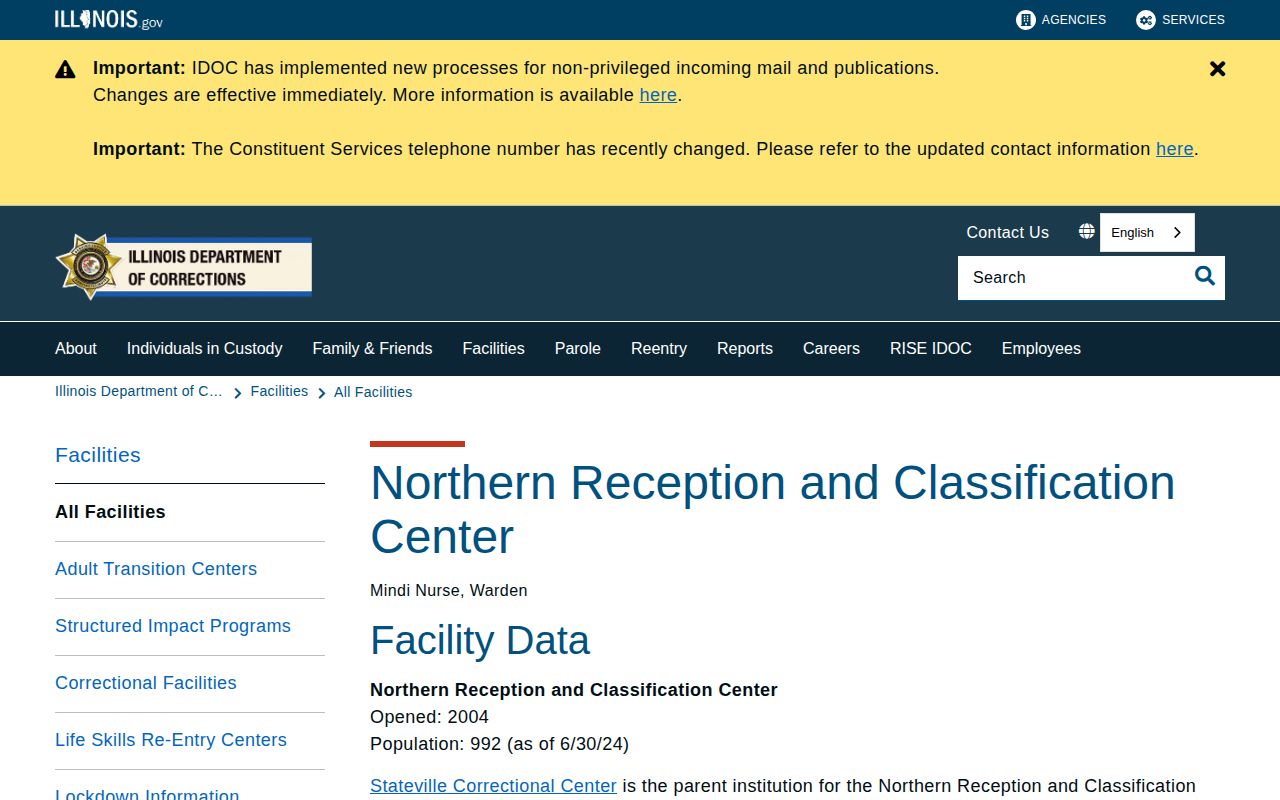
The facility description confirms intake and contact context. Person-specific movement still comes from the IDOC profile and records office.
NRC’s statewide role is locally distinctive. Someone housed there may have no Will County case at all. Custodian, not geography, selects the database. Use the Circuit Clerk only when the sentencing case is actually in Will County, and use the court in the sentencing county otherwise.
NRC Final Discharge Gap
IDOC warns that a person may return “not found” after completing sentence or parole. A missing profile can also reflect a different name, county-only custody, another state, or search error. It cannot be labeled proof of release. This public-search limit is especially important for NRC because an earlier intake record may no longer be easy to trace after the whole state sentence ends.
When the profile is gone, contact IDOC and request admission, transfer, parole or MSR, and final-discharge dates. PRB’s early/final discharge records may add the Board decision where applicable. The sentencing court supplies the durable legal order. Those records perform different jobs and may need to be reconciled.
- Parole
- Conditional community release under the applicable Illinois framework.
- MSR
- Mandatory supervised release after many determinate prison terms.
- Discharge
- The end of the full correctional sentence and supervision.
- Transfer
- A move between custodians or IDOC locations, not community freedom.
NRC Notifications and Photos
Illinois VINE interfaces with IDOC and can provide custody-change notifications. Find the correct IDOC record while it remains active, select the notification option, and follow the phone, text, email, or app steps offered. A transfer alert fits NRC’s core function and must not be called a release alert unless the event itself says release. Confirm every alert with IDOC.
IDOC profiles may contain front and side images plus sentencing details. A photograph can help match identity, but it does not prove current custody or final discharge. Request an official record if the public profile disappears. VINE is a notification service dependent on agency feeds, not a permanent discharge certificate.
No official NRC public release schedule was found. Do not arrange pickup based solely on Projected Parole Date. Reconfirm near the date through IDOC and VINE, then obtain current instructions from the institution actually shown on the record.
NRC Federal Custody Checks
NRC is a state facility, not a federal or ICE detention center. No active BOP institution or civil ICE detention facility was confirmed in Will County. If another authority may follow IDOC custody, request the receiving agency from IDOC and check that agency’s locator or court record.
A BOP result marked Released ends BOP custody only. ICE ODLS covers a limited current and recent period. Neither system should be used to guess what happened when a person merely moved out of NRC. The IDOC transfer record remains the first source.