
Will County VINELink Coverage
Illinois VINE is a free statewide custody and case notification system. The Attorney General says it interfaces with county jail booking systems, IDOC, the Illinois Department of Human Services, and circuit court clerks. The Will County Sheriff separately confirms local participation and says VINE can check custody and notify a registrant when someone leaves the Will County Adult Detention Facility.
Coverage does not make every event equivalent. A release from the ADF ends that Sheriff booking, but it may represent a community release, a transfer to IDOC, or movement to another authority. An IDOC alert concerns state custody. A circuit-court event may concern a case rather than the exact moment the jail completes physical processing. Read the agency name and event type before drawing a conclusion.
| VINELink item | How to read it |
|---|---|
| Name and identifier | Use them to separate people with similar names. |
| Custodial agency | Shows which jail or state system supplied the event. |
| Custody status | Reports the current feed status, subject to processing lag. |
| Facility or location | Identifies the participating custodian when displayed. |
| Event notice | May report release, transfer, escape, or another supported change. |
Search a Will County Inmate
Use the official Illinois VINELink portal, not a generic agency directory. VINELink works best when the correct person can be found while still in custody. Have a booking number, IDOC number, date of birth, or other known identifier ready. A name alone can produce a false match.
- Choose Illinois and open the custody or offender search presented by the current interface.
- Enter the requested name or identification fields. Search alternate name forms only when supported by known records.
- Compare each result’s agency, identifiers, and available descriptive details. Do not open a record solely because the name matches.
- Select the record tied to the correct Will County or IDOC custody. Read the current status and agency before any date or event.
- Save the booking or IDOC number. It will help the Sheriff or IDOC confirm an alert later.
The broader Will County released inmate search is the better path for a past release when no active VINE record remains. For a county booking, the Sheriff Press inquiry may retain the exact release date and time. For a state sentence, IDOC may show current parole or supervision data, though a fully discharged person can disappear from public results. Check the newest relevant booking and any multiple-booking marker. An old release timestamp can belong to an earlier stay while a newer custody episode remains open.
Open the official Illinois VINELink search screen to see the current person-search interface.
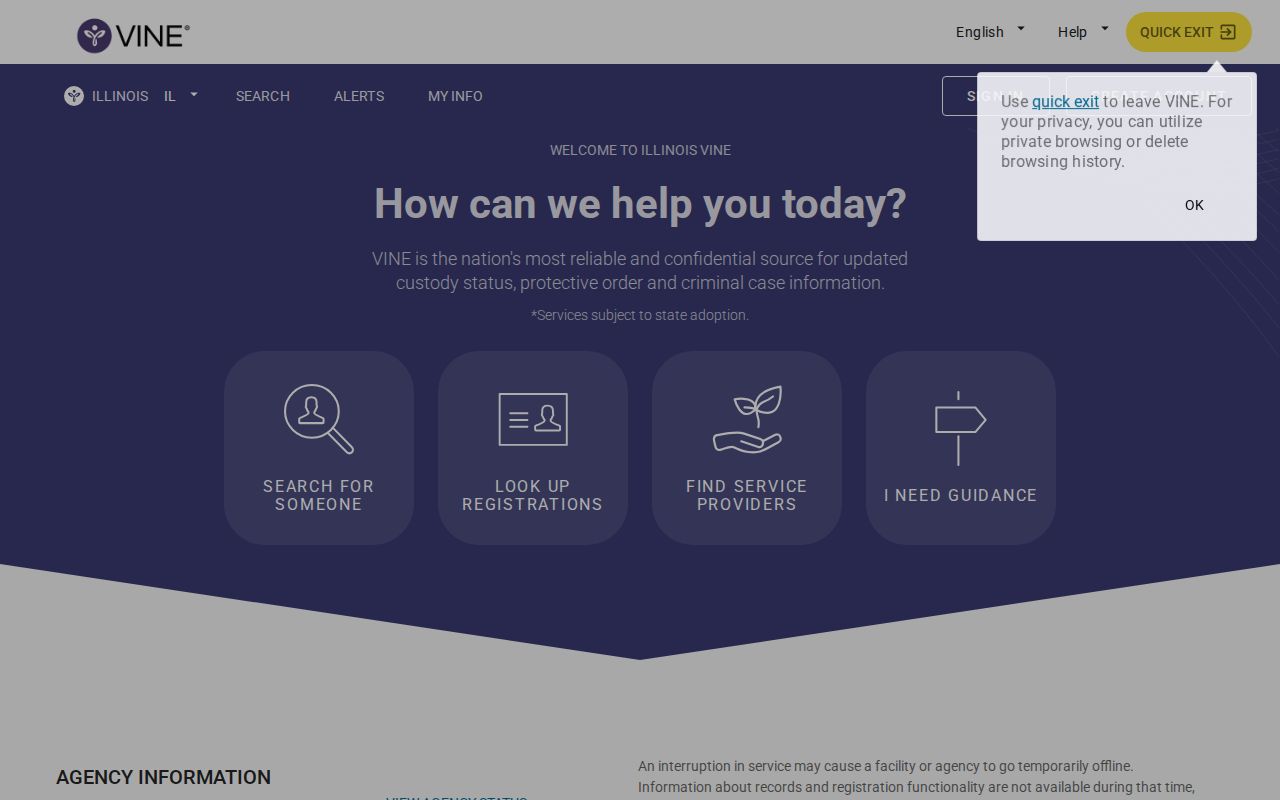
The captured screen establishes the official person-specific search route. Exact labels may change, so the live record and custodial agency should control.
Will County Released VINE Results
Official overview material does not promise one universal label for every released result. Do not translate a blank, missing record, or changed screen into “released.” If a released result appears, record the exact wording and date shown on the live screen, identify the feeding agency, and then compare it with the custodian’s record.
For a Will County jail event, the Sheriff’s historical Press detail can show the exact Release Date and time for that booking. The Public inquiry is current-custody oriented and is only a cross-check. For an IDOC event, read Offender Status, Location, Last Paroled Date, and projected fields together. A Last Paroled Date can reflect a past physical release even if a later violation returned the person to custody.
Feed timing can trail physical processing. A judge’s order can also precede the ADF’s completed release. The Sheriff’s processed timestamp is stronger proof that the Will booking ended, while the court docket explains the legal authority. Neither should be silently replaced by the time a VINE call arrived.
Register Will County Release Alerts
Registration starts from the correct person’s record. The interface may offer phone, text, email, or app delivery. Options can vary, so use only the channels shown. Will County says telephone registration is anonymous and that phone and PIN information is not accessible to others through the service.
- Find and verify the person while the VINE custody record is active.
- Select the register or notify option on that record.
- Choose an offered channel and enter the phone number, email address, or app destination.
- For a phone alert, create a memorable four-digit PIN. Email registration does not use that phone PIN.
- Complete the confirmation shown by the interface. Registering more than one phone number may require separate entries.
- When an automated call arrives, listen to the event and enter the PIN to acknowledge it.
If the correct PIN is not entered, calls may repeat at intervals for up to 24 hours, depending on the event. Will County advises using the same PIN when several numbers are registered. Calls can arrive at any hour because release and transfer processing does not follow a notification recipient’s schedule.
Note: Keep the PIN private but memorable because entering it acknowledges a phone notice and stops repeat attempts for that event.
Will County VINE Local Layer
The Sheriff’s Will County VINE information page adds local detail beyond the statewide portal. It specifically describes calls when a person is released or transferred from the ADF, English and Spanish availability, and use of the four-digit PIN. The local information number is 815-740-5560. Statewide live operator help is available at 1-866-566-8439.
This local layer matters because “leaves the facility” is broader than “goes home.” A person can leave the ADF for IDOC, another county, or another authority. The alert reports a custody event from the agency feed. The receiving agency, Sheriff booking detail, and court disposition provide the context needed to distinguish a transfer from community release.
IDOC Victim Services may assist with state correctional matters, but IDOC says it does not administer VINE and cannot access registration data supplied to the system. Technical or registration help belongs with VINE. State custody confirmation belongs with IDOC.
Will County Registry Differences
Illinois offender registries are separate from VINELink and apply only to people with a statutory registration duty. The Illinois State Police Sex Offender Registry and the Murderer and Violent Offender Against Youth Registry support limited name, location, and compliance searches. Their agencies state that those registries are updated daily. The Methamphetamine Manufacturer Registry covers qualifying convictions from the statutory period.
A registry entry may help corroborate that a qualifying person has a community record. It does not prove the date a Will County jail booking ended. Compliance wording speaks to the registry duty, not whether every court or supervision term has ended. Absence from a registry says nothing about release unless the law required that person to register. Contact the registering agency if a registry detail needs confirmation.
Review the official Illinois registry disclaimer and search entry before using its limited record.
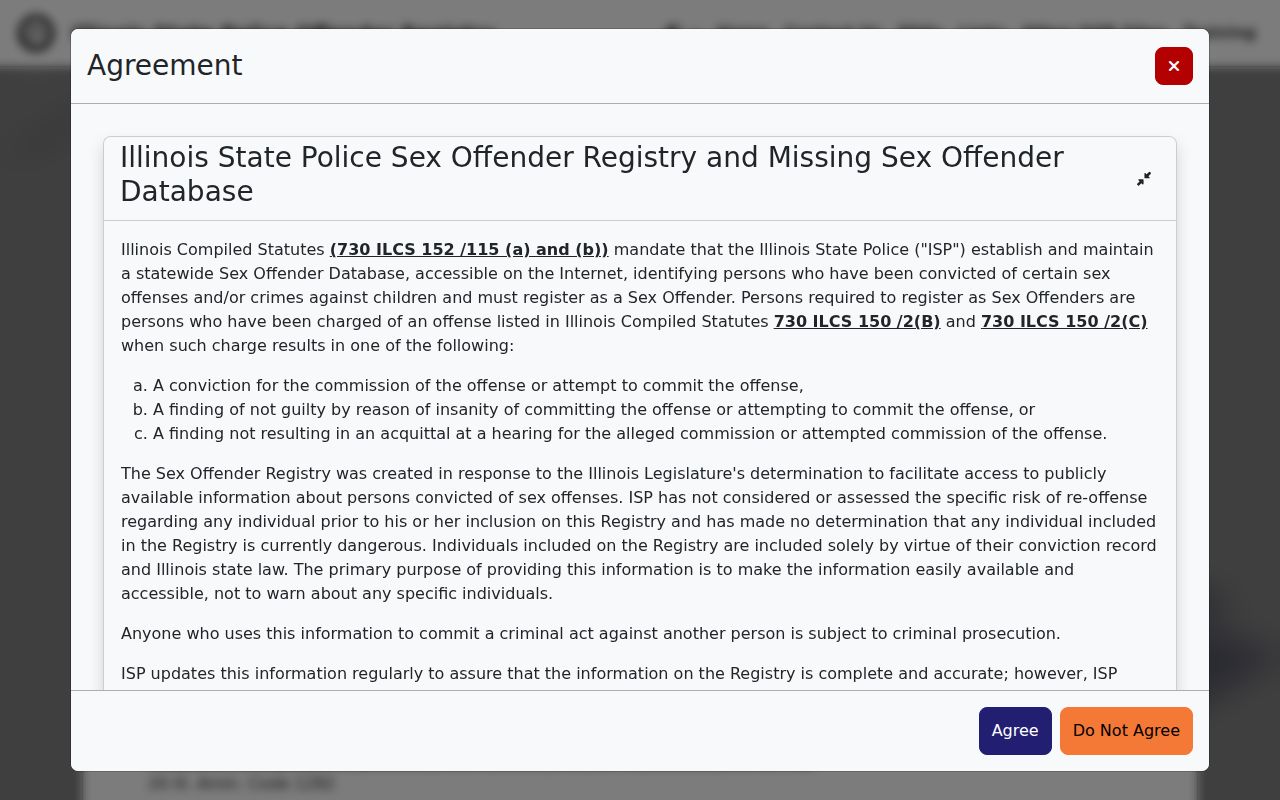
The registry screen illustrates a separate qualifying-record system, not a general VINELink release search.
Confirm Will County VINE Alerts
After an alert, use the channel that owns the custody. Call the Will County Adult Detention Facility at 815-740-1250 and check the Sheriff Press booking detail for a county release. Search IDOC and call 217-558-2200 for a state record. A court case alert should be checked against the Will Circuit Clerk docket and, when precision matters, the filed order.
Illinois VINE does not cover the federal Bureau of Prisons, ICE, or every federal hold. Use the BOP locator for a sentenced federal person. Use ICE’s Online Detainee Locator for current ICE detention and its limited recent-release window. A federal pretrial outcome is found through the federal docket because the U.S. Marshals Service has no public release locator.
Keep a note of the event wording, time received, agency, and identifier. That small record makes a follow-up call more useful and prevents a county jail alert from being confused with an IDOC or court event.